


- Details
- Written by: Simon Dallyn
Whenever I walk in the park this time of year I am overcome by the number of birds singing. Although I can recognise the Robin, the Blackbird and the Great Tit, it's difficult to sort them out while they are all singing at once.
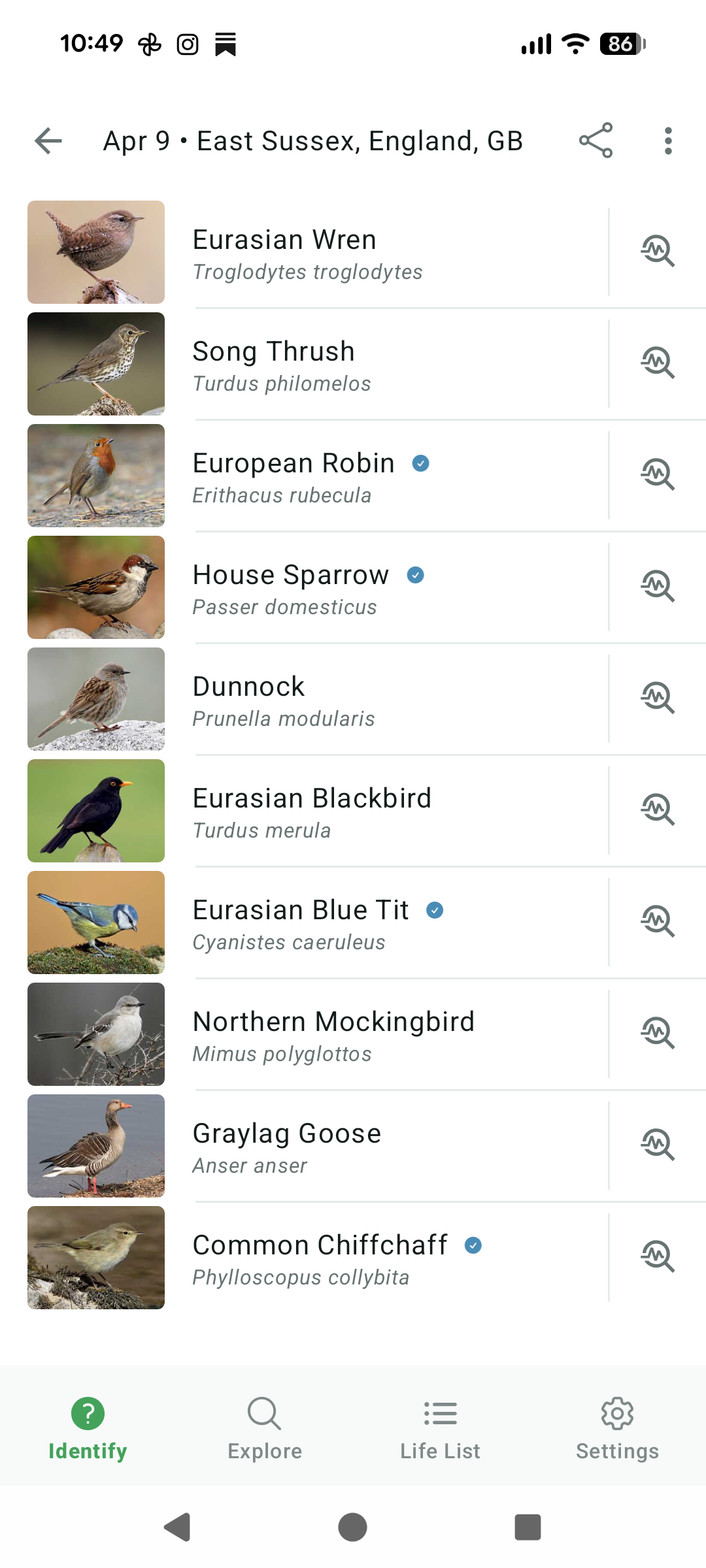
Maybe you have already done this, but try downloading the Merlin app for your phone. Here is a screenshot of what it found in just 30 seconds as I entered the park off Barley Lane. A particular treat to hear a Song Thrush. The app does make the odd mistake, so I suspect the Northern Mockingbird was not real(!), but the others are solid detections.
What is even better is that the bird that is currently singing is highlighted, so you can learn to recognise them by careful listening. A beautiful reminder of an amazing spring morning,
The app is designed by the Cornell Lab of Ornithology, so it's got serious scientific backing and your sightings (hearings ?!) contribute to their research.
9th April 2026.
- Details
- Written by: Michael Moor
A March morning in Ecclesbourne Glen, captured by Michael Moor, a member of the Friends of Hastings Country Park Nature Reserve.

- Details
- Written by: Andrew Colquhoun
Some new research from the UK Centre for Ecology and Hydrology (CEH) suggests that getting involved in “citizen science” out in the natural world can boost the sense of well-being of volunteers taking part.
The CEH scientists studied the effects of citizen science projects on 500 participants with an average age of 52. They found that as well as gathering useful data on such things as beetle counts or mapping ancient trees, the volunteers felt significantly happier afterwards and closer to nature.
One project involved participants counting pollinating insects on a patch of plants, distinguishing between bumble bees, wasps, hoverflies, solitary bees and beetles etc. This activity had a direct and positive sense of greater appreciation for the natural world. As one volunteer said “It reminded me that small things can make a big difference to my mood”.
There is a really interesting citizen science project has been going on recently in Hastings Country Park Nature Reserve. As part of the grant which the Friends were given to mark the Queen’s Platinum Jubilee, Groundwork South has been doing work on harvest mice in the Reserve.
The Mammal Society were invited to the Reserve to deliver training workshop with volunteers for a harvest mouse survey. The group then went out and conducted Hastings Country Park Nature Reserve’s first harvest mouse survey. Six nests were found!
Since then another training session has taken place and a further 4 surveys led by Jill Tyson, Groundwork’s Conservation & Volunteering Officer. A total of 32 nests have been found so far, which is great news as harvest mice are a threatened species with a declining population. Not only has this experience given volunteers new skills and an active role in the conservation in the park, the records will be submitted to the Mammal Society and will influence future conservation efforts for this species. The volunteers enjoyed the experience and are keen to continue surveying in the future.
- Details
- Written by: Andrew Colquhoun
Which book? Swifts and Us, by Sarah Gibson is full of little known facts about the birds that sleep in the sky and that are now back with us for an all too short three months. So did you know (I didn’t)?
* Back in the day (i.e. geological time), swifts and hummingbirds share a common ancestor. Despite appearances, swifts are classified into different bird families from swallows and martins.
* Also back in the day (nearer to our day), swifts were the object of superstition and even fear because they seemed so mysterious. Hence, country names such as devling, sker-devil and black imps.
* Swifts mate on the wing, the only bird species to do so. Is it quick? It’s certainly swift, and sometimes noisy as the pair descend locked together from the sky.
* The swift which we see in the UK is called “common” because it is the most numerous across the world. But there are about 100 different species of swift globally. Occasionally, we get visits by the larger alpine swifts as vagrants on the south coast, but you need to go further south to see them regularly.
* For the nine months of the year when they are not with us, common swifts migrate to east and central Africa, particularly the Congo basin, but they come back to the northern hemisphere to breed and raise their young. Ringing and tiny geolocators have now removed some of the mystery about migration patterns for swifts and other species
* The swifts spend their entire time in the air until they are ready to breed in their fourth year (if they have survived that long). Even then, they only come to their nests in holes or boxes or under the eaves to lay their eggs and feed the nestlings. Other than that, they are up in the sky.
* Swifts feed upon micro-spiders and insects such as aphids, hoverflies and plant bugs which they find flying or floating in the sky. A pair of adults might catch 20,000 insects and spiders in day to feed their young, glued together into “feast balls” every hour or so.
* But even swifts need to sleep sometimes. This too happens in the air: at dusk, they will ascend, possibly up to 3000m on warmer nights, and then close off half the brain as they circle until dawn, and then wake up in more or less the same spot in the sky for another day’s hunting.
* Bird’s nest soup is made in eastern Asia from the nests of the “edible-nest swiftlet”. This soup seems to involve a lot of saliva secreted by the birds to bind their nests. So prized is this soup with supposed medicinal benefits, that thousands upon thousand of concrete nesting towers have been built in the region to harvest the nests. They provide an astonishing percentage of Indonesia’s national income: 5% by some estimates! What the swiftlets think about the theft of their nests, for something which Mao regarded as a decadent habit, is sadly unknown.
* Finally, the curious fact that swifts seem to be right-handed. Handedness (or perhaps that should be footedness) has been seen in other animals such as parrots. Given a choice of a row of nesting boxes, swifts will normally pick the right-hand ones. Here in East Sussex, check out the Hastings and Rother Swift Conservation Group via e-voice.org.uk to learn more about these fascinating birds and how you can help.
Andrew Colquhoun
- Details
- Written by: Andrew Colquhoun
Stephanie and I went out again recently to watch bird-ringing at a station east of Hastings. The highlights were a bearded tit and a tiny, tiny firecrest.
But the team there also trap moths for recording and release. This gives valuable data about population health, new species and so on. We were really impressed by the recorder’s ability immediately to identify any one of well over 100 species that might have entered the light trap overnight. That’s real expertise, based on many years of experience.
There are reckoned to be over 2500 species of moth in the UK (compared to only about 60 butterfly species). Most of these moths will have both Latin names and English ones. Some of the English names are truly wonderful. Their origins are often lost in history. But who came up with the name “setaceous hebrew character”, or “the confused “, or “the snout”, to pick just a few moths at random from Complete British Insects by Michael Chinery?
The three photos here are of moths found in the trap last week. None of them is rare, but they are all classic autumn moths for this part of the country, each with their own distinctive English name: black rustic, angled shade, and green brindled crescent.


